Polity Class 33
A BRIEF OVERVIEW OF THE PREVIOUS CLASS (05:15 PM)
CENTER-STATE FINANCIAL RELATIONS (05:17 PM)
SPECIAL CATEGORY STATUS
- Hilly states were arguing that they need more assistance than the normal states.
- 4th FC asked the planning commission to come out with some special procedure to assist these states.
- Planning Commission came up with special category status to provide financial assistance to states which are relatively backward.
- Planning Commission came up with criteria
- a) Difficult and Hilly terrain
- b) Proportion of Tribal population in the overall population
- c) States having international borders
- d) Those states who are having unsustainable revenue deficit or Fiscal deficit i.e. financially poor

- Benefits
- a) For centrally sponsored schemes the sharing is 70:30 or 60:40 between the centre and normal states and 90:10 between the centre and Special category states
- b) Tax concessions are given to industrialists
- c) Soft loans
- d) Central government will also write off the loans.
- When Andhra Pradesh was created in 2014, it was promised a special category status for 5 years as it was not scientifically divided. Hyderabad contributed 70% of the revenues went to Telangana. It was not fiscally sustainable for Andhra Pradesh.
- In 2014, BJP came to power and denied special category status to Andhra Pradesh.
- 14th FC also increased the states revenue from 32% to 42%, so it also recommended that now there is no need to provide Special category status to states.
- In Rajya Sabha, the Opposition party introduced a Private Bill but BJP argued that this is a money Bill and thus it should be referred to the speaker. The Bill was later turned down.
- Problem with the states
- States are not willing to collect taxes. Agricultural income is not taxed. There are too many concessions and loopholes. So states need to improve tax collection and cut down the revenue expenditure.
- State governments were not able to maintain fiscal discipline
- States were engaged in competitive populism [* Competitive populism = Race to the bottom. One state is offering 1000 rs as a subsidy then another state is offering 2000rs in the name of populism]
- [* Competitive Federalism means states are having healthy competition in improving social indicators such as Health, education, etc as per the ranking given by NITI Aayog.]
- NOTES
- Special category status is given to those states which are facing difficulties due to their topography and also because of their weak financial situation. At present 11 states enjoy special category status.
- It has become controversial because then PM Manmohan Singh promised special category status to Andhra Pradesh because of the weak financial situation of Andhra Pradesh after its division.
- A private member was introduced in Rajya Sabha but it was rejected because the speaker categorised the Bill as Money Bill. It led to demands for special category status from many other states including Odisha, Chattisgarh, Bihar, West Bengal, Rajasthan, and others.
- In 2017, Central Government extended special category status to the existing 11 states for a period of another 10 years. It has rejected the demands of all other states.
- Way Forward
- Instead of seeking special category status, states must focus on improving their financial situation by raising revenues through the imposition of new taxes like Agricultural income tax.
- They must also focus on cutting down unproductive expenditures in the form of populistic subsidies.
- The country at present is witnessing this unhealthy trend of competitive populism among political parties and state governments. It must be transformed into competitive federalism with state governments competing with each other in terms of Per capita income, standard of life, Infrastructure development, industrialization, and human development.
- They must focus on financial independence rather than depending hopelessly on the central government for their survival.
SHARING OF INTER-STATE WATER/ INTER-STATE WATER DISPUTES (05:54 PM)
- Why sharing of river waters is not a big problem in the north and it is a big problem in the South?
- Geographical problem
- a) In south India the rivers are not perennial and are seasonal
- b) In South India, rivers flow vertically, thus dams can be constructed to stop the flow of rivers. Whereas in North India, rivers flow horizontally.
- In the south, the upper riparian states can construct dams and this becomes a problem for lower riparian states.
- Historical problem
- When EIC occupied India, more land was brought under agriculture so that they can earn huge revenue.
- The western part of South India was under the princely states whereas the Eastern part of South India was directly under the British state.
- EIC constructed dams on Krishna, Godavari, and Cauvery to bring more land under agriculture.
- Green Revolution started in North Coastal Tamilnadu and Coastal Andhra Pradesh.
- After Independence, the Reorganisation of states happened on linguistic lines. The government invested the maximum in the construction of dams during the 1950-1960s.
- Maharashtra and Karnataka invested more in the construction of dams and huge land came under Agriculture. They started cultivating Rice. This required more water.
- In the late 1960s, the GoI introduced many reforms such as MSP to encourage farmers to produce more. Due to this farmers shifted to Rice- wheat cultivation.
- In south India, 1000 hectares of land came under Agriculture and they were cultivating Rice and wheat.
- During the Weak monsoon, the upper riparian states closed the gates of the dam.
- Ecological dimension
- Usage of water- Israel uses 125% of the rainwater whereas India uses only around 7% of the rainwater (Mihir Shah committee)
- When there is excess rain, the dams are full, upper riparian states open the gates and water goes into the ocean.
- CONSTITUTIONAL PROVISIONS
- Article 262- Parliament may by law provide for the adjudication of any dispute or complaint with respect to the use, distribution or control of the waters of, or in, any inter-State river or river valley.
- The tribunal consists of only irrigational experts
- The award given by the tribunal is final, however, the SC can hear the award given by any tribunal under the special leave petition (Article 136).

- Tribunals cannot provide a permanent solution.
WAY FORWARD FOR INTER-STATE WATER DISPUTES (06:25 PM)
- All the southern states are growing only Rice due to MSP provided to Rice. Let the government provide MSP to all the crops.
- Let the corporates sector procure directly from farmers
- Increase in farmer-producer organizations.
- Shift in the cropping pattern and promotion of Dryland farming
- The government can increase the Agriculture extension services
- Economic survey pointed out that among all the BRICS countries, India is using maximum water in agriculture and India is wasting more water. India uses "Flood irrigation" so India needs to shift from Flood Irrigation to "Micro Irrigation" (Sprinkler irrigation, Drip irrigation).
- Every state needs to move from "Competitive Populism" to "Competitive Federalism".
- States do not have proper data about the requirement of water and also the meters are not attached to water pumps. Water and electricity are given free of cost. As a power sector reform, the states are now required to attach meters to the motors.
- Excessive utilization of water also increases the salinity of the soil.
- Government can also charge for the usage of water and electricity. [* Ethical dimension- Wealth without work is a sin as per Gandhi Ji]
- The states are only interested in constructing multi-purpose irrigation dams due to Political populism. This is prone to earthquakes, it also uses huge amounts of land.
- [* 2018- Kerala witnessed severe rainfall i.e. 60 cm. Tamilnadu opened the gates of Periyar Dam. The entire state of Kerala was under 4-5 feet of water]
- State government can construct the canal. These canals can store the rainwater during the excess rainfall and they can provide water during the drought.
- Let the state government should charge fees for water usage from the households.
- Every Urban local body is indulged in Political populism. This led to a decline in the water table.
- Every Urban body can make a mandatory provision for Rainwater harvesting in urban buildings.
- In rural areas, India can reduce the independence of farmers in agriculture and promote other industries.
- Rainbow revolution can be promoted in Rural areas
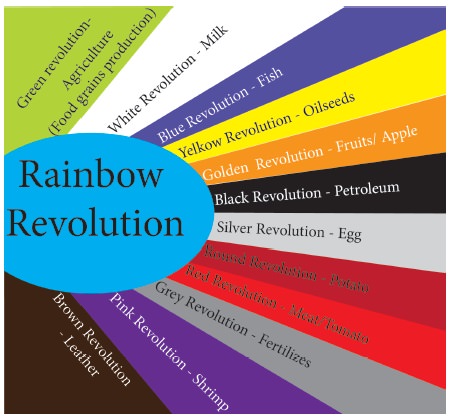
- Integrated farming systems can be promoted in Rural areas. [* Integration farming system= Agriculture + Allied sectors/ Horticulture/ Dairy/ Livestock]
- Interlinking of river waters can be promoted. This was also advocated by SC.
- [* Pattiseema Lift Irrigation Project is a river interlinking project which connects the Godavari to Krishna River.]
- The Constitution of a single tribunal with different benches along with the fixation of strict timelines for adjudication will result in expeditious resolution of disputes relating to inter-state rivers.
- Government can Nationalize the river waters.
INTER-STATE BOUNDARY DISPUTES (07:15 PM)
- The mechanism to resolve inter-state boundary disputes is the Ministry of Home Affairs.
- MHA constitutes a committee comprising important ministers from both the states and important ministers from the central government also.
- If the dispute is not resolved through negotiation then states can approach the Supreme Court.
- Example- Telangana v/s Maharashtra border village disputes.
EMERGENCY PROVISIONS (07:19 PM)
- Article 352- National Emergency
- It can be imposed when the security of India is threatened by war or external aggression or Armed Rebellion. 44th Constitutional Amendment replaced Internal disturbances with Armed Rebellion.
- It can be imposed for both internal and external reasons
- For the first time, it was imposed in 1962, again in 1965, and also in 1971 due to war. In 1975, an emergency was imposed due to internal disturbances.
- In the Minerva Mills case, SC held that the proclamation of National emergency can be challenged in courts on Malafide grounds.
- The proclamation of National emergency must be approved by both the house of the Parliament within a month.
- The national emergency must be approved with a special majority i.e. 2/3rd of the members present and voting. There is no scope for Joint sitting.
- The emergency will be in operation for a period of six months and can be extended indefinitely with the approval of Parliament after every six months.
- Revocation of Emergency
- It can be revoked by the President at any point in time after its proclamation. It does not require Parliamentary approval.
- It can also be revoked if Lok Sabha passes a resolution with a simple majority, then the President must revoke it.
- If the Lok Sabha is dissolved before the one-month period without approving an emergency, Rajya Sabha must approve with a special majority within one month period and the first sitting of the new Lok Sabha must approve an emergency within one month.
- Impact of National Emergency
- State governments are under complete control of the central government. The legislative power of the state is not suspended but parliament can override state legislature.
- Parliament can also make legislation for items in the state list. Those laws made by the parliament would become inoperative after six months of the repeal of emergency
- If the emergency is imposed due to internal reasons, all Fundamental Rights are suspended except Articles 19, 20, and 21 (Article 358)
- During times of war and external aggression, Article 19 can also be suspended. Articles 20 and 21 remain in operation.
- SC ruled that a Habeas Corpus writ can be filed even during emergencies also.
- Article 356- State Emergency/ President's Rule (07:46 PM)
- Under Article 355, the central government has a duty to ensure that the state government is carrying out its administration strictly according to the provisions of the constitution.
- The central government can implement the president's rule in case of failure of constitutional machinery in a state.
- Under Article 356, President's rule can be imposed on two different grounds
- a) If there is a breakdown of constitutional machinery, Governor sends a report and on the basis of this report, President can impose Article 356. It can be imposed without the governor's report also.
- SC in the Bihar Assembly dissolution case has ruled that the Governor's report need not be the basis for the imposition of Article 356. It held that the central Government must independently verify the contents of the governor's report before taking a decision.
- b) Under Article 365, whenever a state fails to comply with any direction from the centre then the president can impose Article 356. Under Article 257, the central government has the power to issue directions to the state and it is the responsibility of the states to comply with the directions given by the central government.
- Breakdown of constitutional machinery means
- a) Political instability in the state
- b) No political party is in a position to form government in the existing state assembly
- c) A Chief Minister who has lost the majority on the floor of the house but is refusing to resign.
- d) Breakdown of law and order situation in the state.
- e) Secessionist or terrorist movements in the state which threaten the unity and integrity of the nation.
The Topic for the next class:- Centre-state relations, Rural and Urban development.